Willi-Resetarits-Hof
Architekturplanung
Planungsbeginn: 2021
Baubeginn: 2022
Fertigstellung: 2024
Grundstücksfläche: 3.254 m²
Nutzfläche: 11.881 m²
Bebaute Fläche: 2.971 m²
BGF: 16.988 m²
BRI: 54.965 m³
ARCHITECTURE
Urban design/Building site
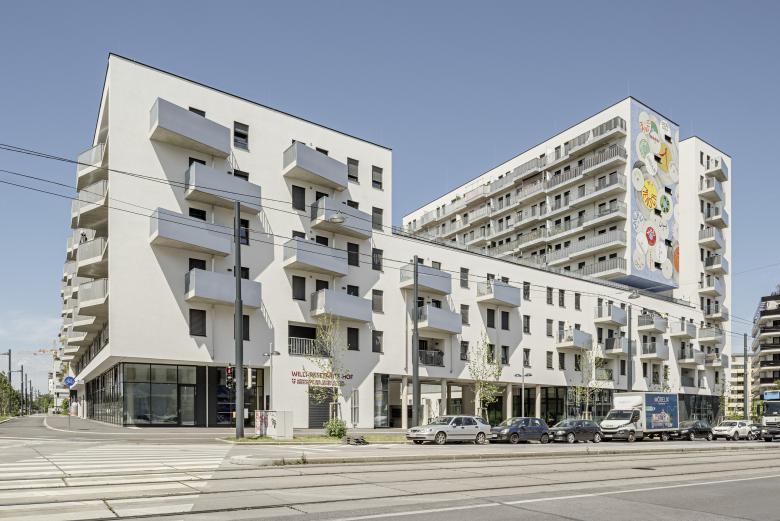
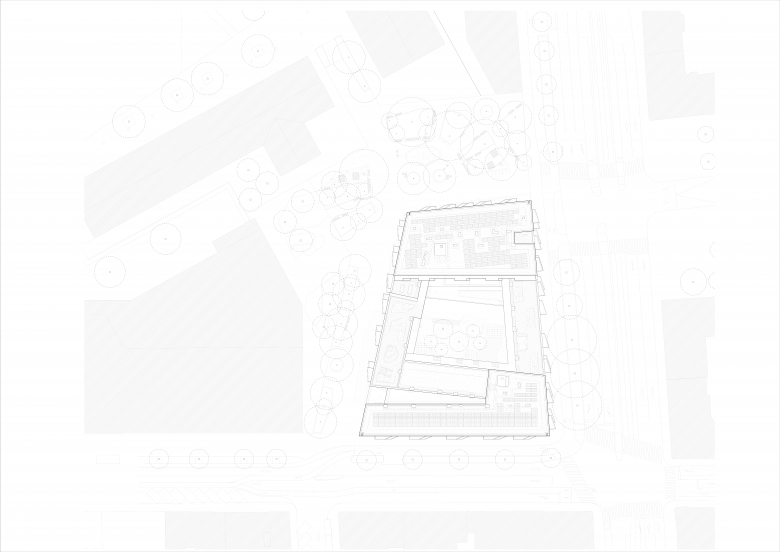
The site forms part of one of the last large development areas in the inner-city area and through its central location offers an enormous range of qualities. It is just a few minutes on foot from the Main Train Station, the Belvedere or the Schweizergarten. Located in Vienna‘s 10th municipal district the Neues Landgut Quartier measures around 9 hectares in area. The present project occupies what is probably the most prominent corner in the entire site. Together with the Gösserhalle and Inventarhalle opposite the corner of Landgutgasse and Laxenburgerstraße forms a gateway to this new district, which is a direct extension of Columbusplatz. On a one-hectare site immediately to the west the new Innerfavoriten education campus is being erected. The urban design model, jointly formulated by the City of Vienna and the property developers ÖBB Immobilien, was issued on 26.02.2019.
Architecture
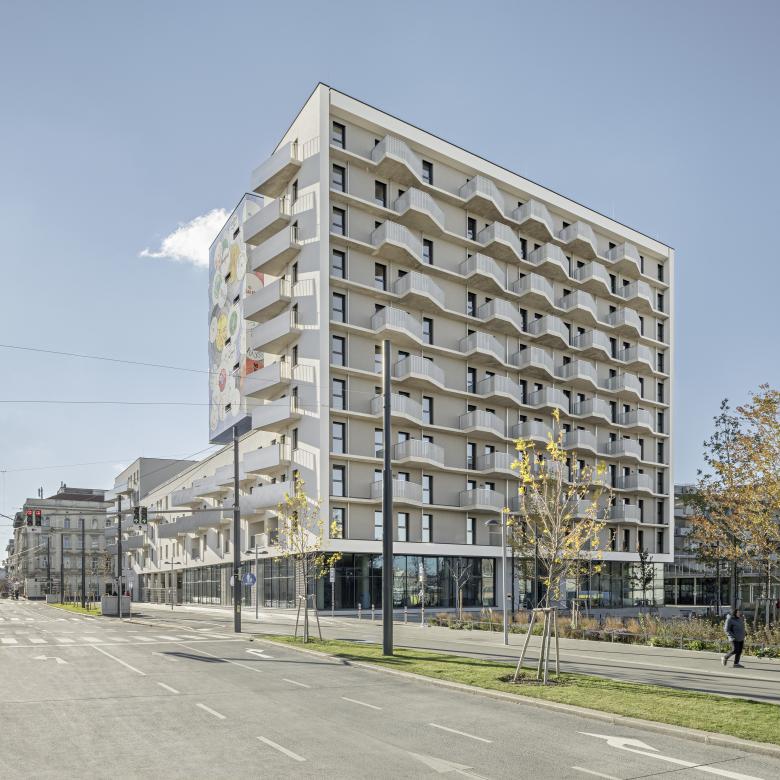
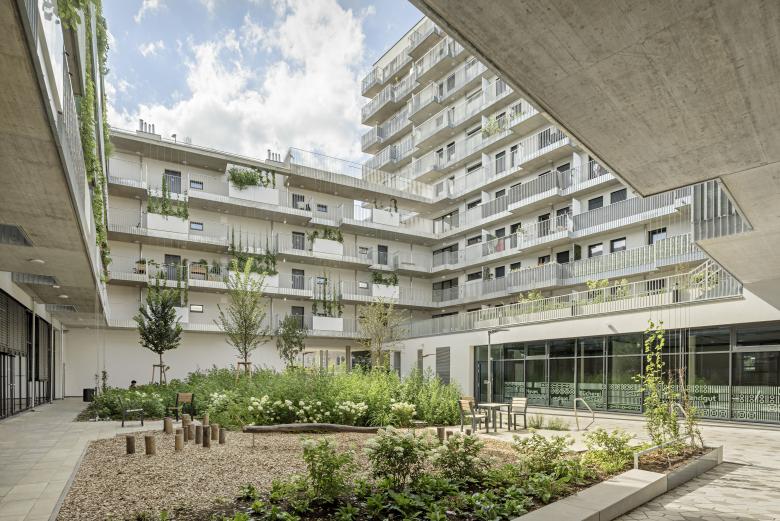
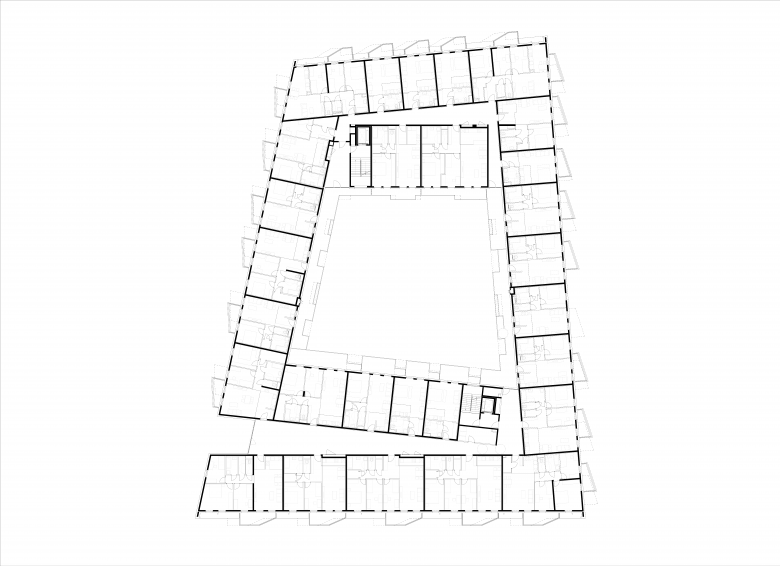
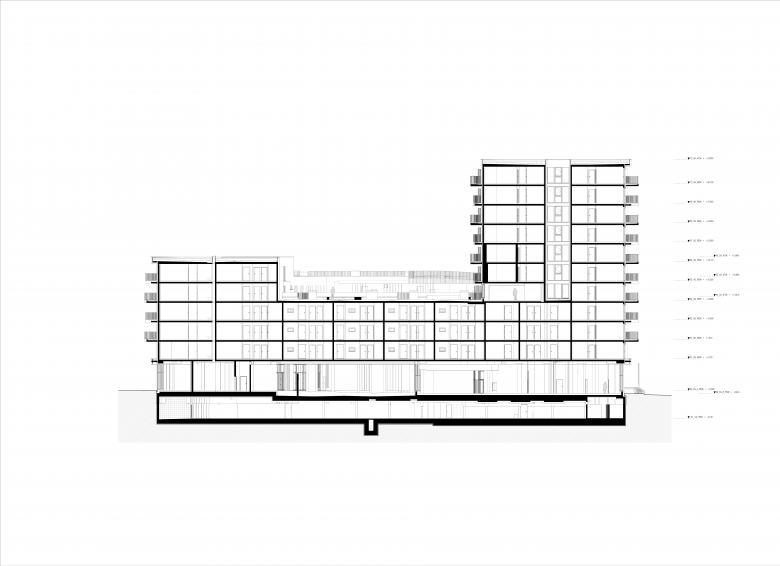
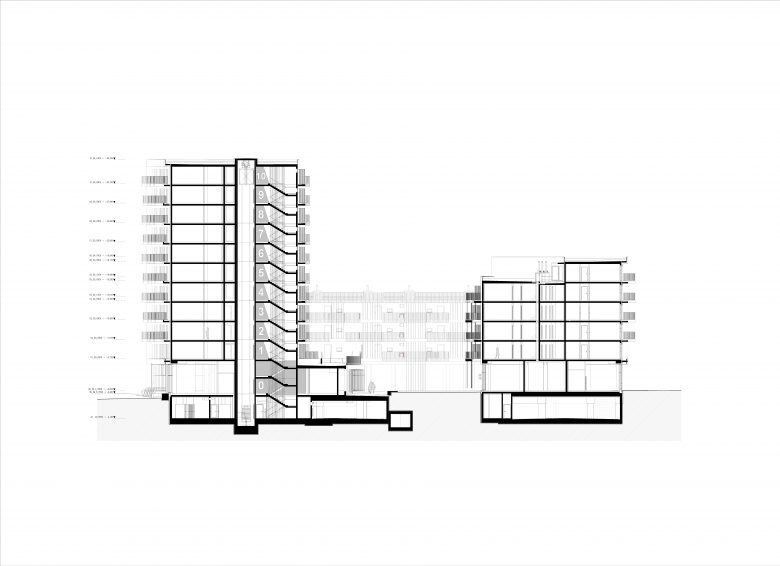
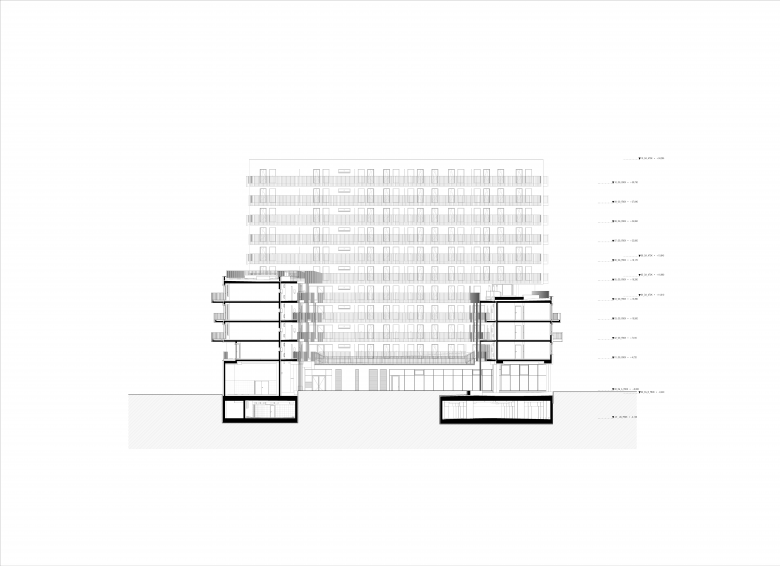
The volume of the building complies with the constraints in the zoning plan. The existing block structure is broken up allowing routes to made through the activated internal courtyard. The two high points are made by means of a central corridor access system which, however, in terms of form differs clearly from the classic design of such circulation routes. Starting from the vertical circulation cores the corridors widen increasingly and through generous glazing at the end of the corridors form a structure that is directed towards the openings.
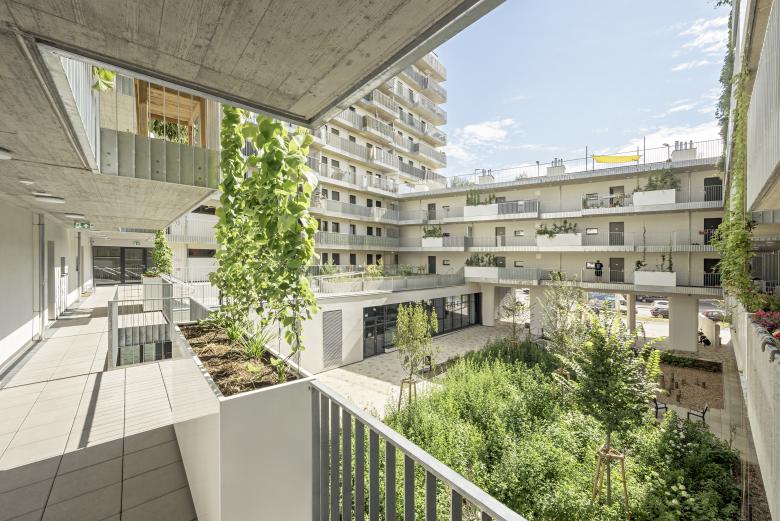
The two deck access wings can also be reached from the circulation cores. The characteristics of this building are continuous corridors in the building’s internal courtyard. In terms of architectural structure, they are based on the classic Viennese “Pawlatschenhof” (an old building type in which the flats are reached from glazed “decks” running along the sides of the building) but are understood as a reinterpretation of this classic building type.
Apartment structure
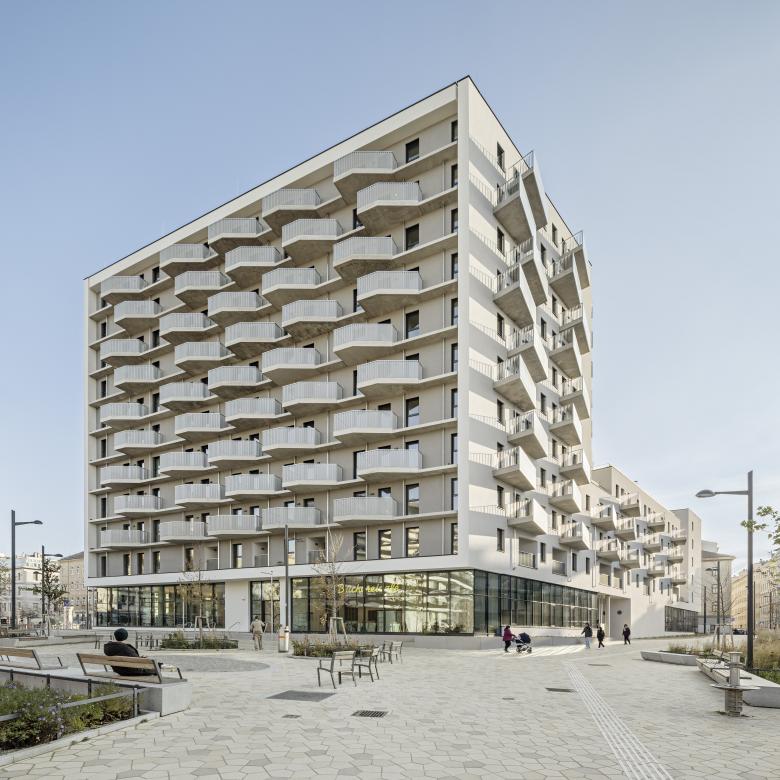
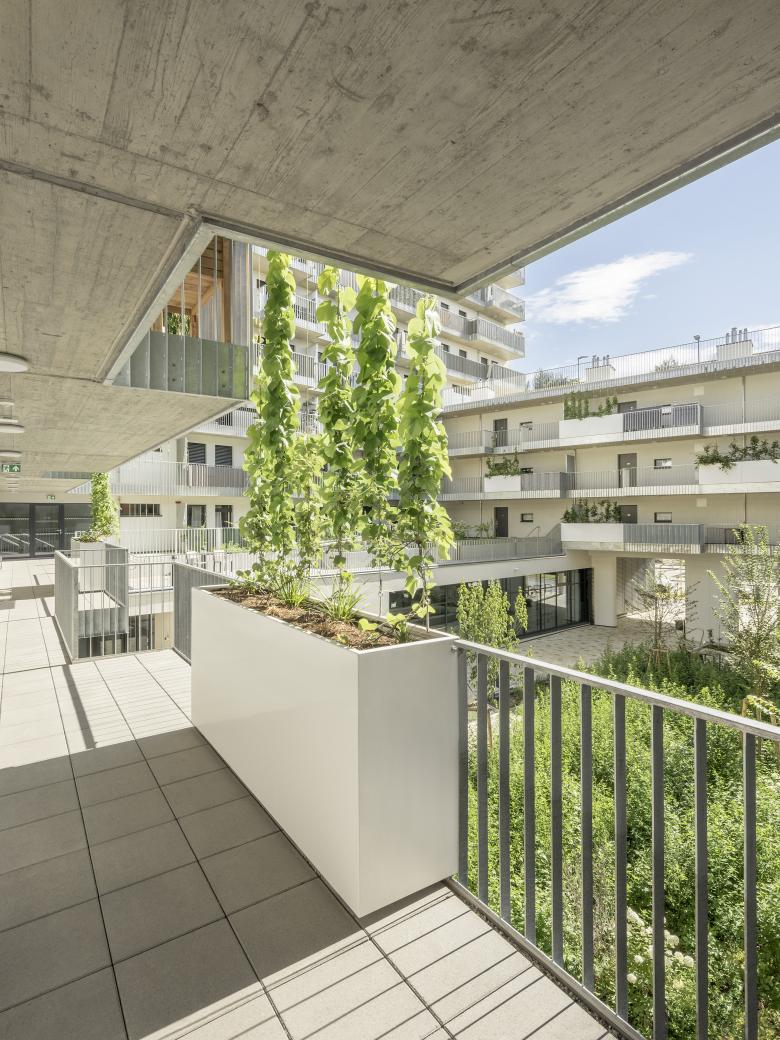
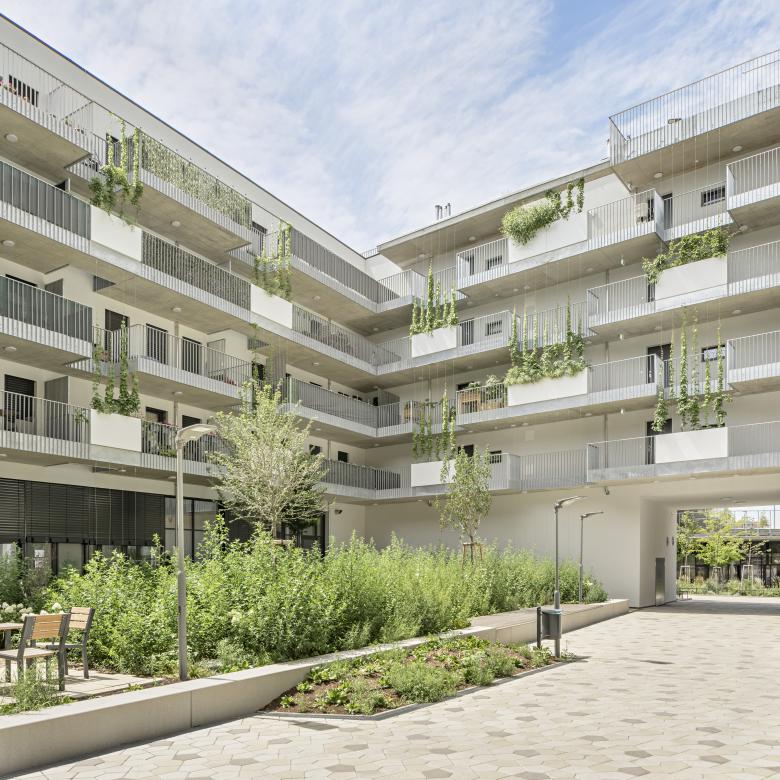
The floor areas and number of the apartments are planned in accordance with the housing key for “Gemeindewohnungen NEU“ (new municipal apartments). In all there are 165 apartments on the site. In addition to a balcony the apartments along the access decks also have a small outdoor space on the deck. Instead of having a balcony on the street side certain apartments are allocated the entire access deck. This is possible where no further apartments are reached from this access deck. The apartment floor plans are based on an established system. From the corridor or access deck you enter a small hall or draught lobby from which, in most cases, the living area is entered. Bathroom and bedrooms are reached from an “intimate corridor”. The wide variety of private outdoor spaces offered is a further identity shaping characteristic. On the one hand there are the access decks and balconies already referred to, but there also individual balconies on the outer facades, continuous balcony slabs on the south facade of the high-rise building as well as loggias on the 1st floor of the building. The angular individual balconies consciously play with the idea of emerging onto the balcony from the living rooms and they grow wider at the far end.
Fire safety
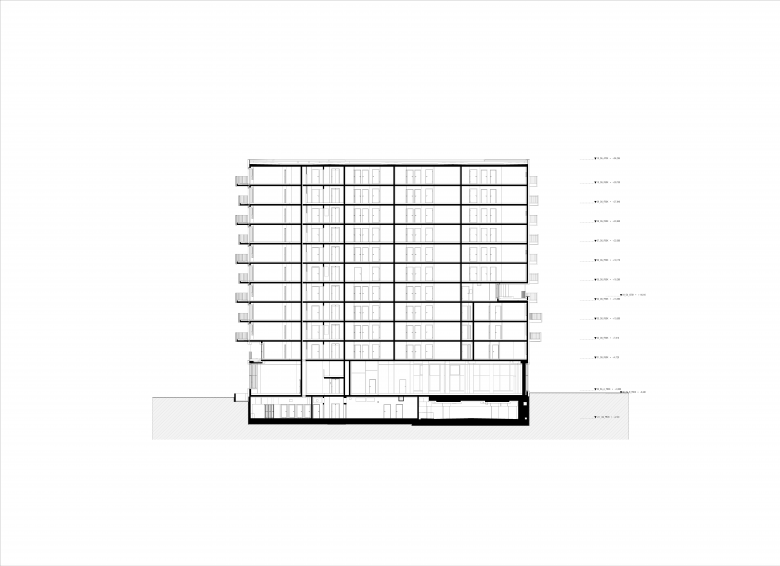
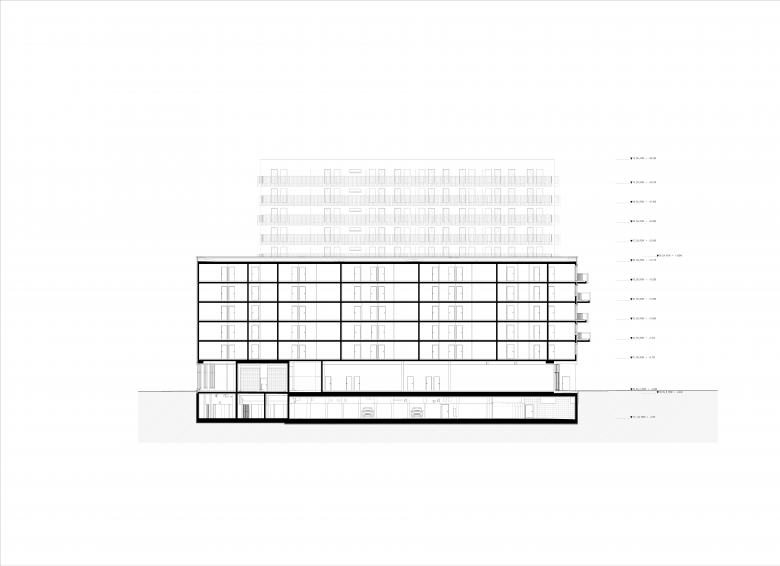
The building is divided into two parts of different heights. Building A has an escape height of maximum 13.55 m. The corridors are connected to the staircase by a lock. At the requisite points all facades can be reached by rescue ladder. Building B has an escape height of maximum 30.90 m. This building has a pressure-ventilated staircase with fire brigade lift. All relevant facades can be reached by fire extinguishing water from designated staging areas. The vertical spread of fire on the northside of building B is hindered by means of continuous fire protection strips. On the other facades fire flashover is prevented by balcony slabs that project sufficiently or by sufficiently high parapets.
ECOLOGY AND DESIGN OF OPEN SPACE
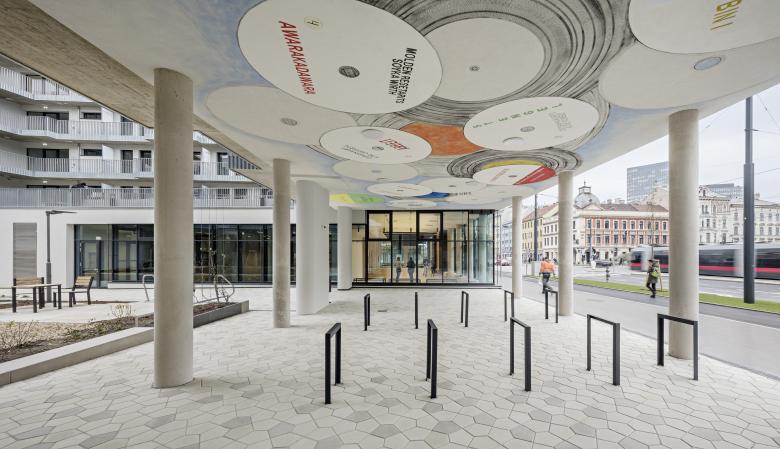
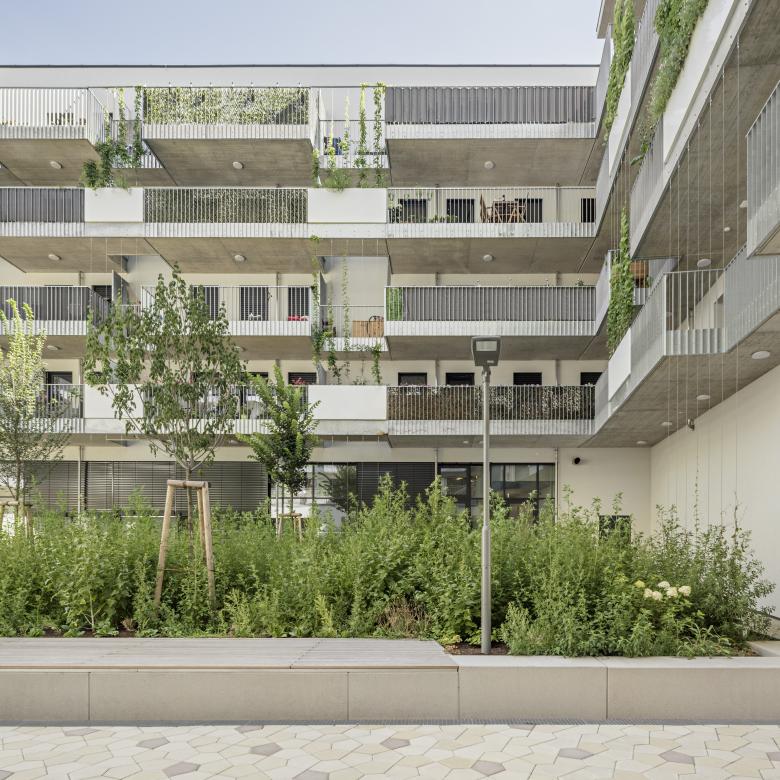
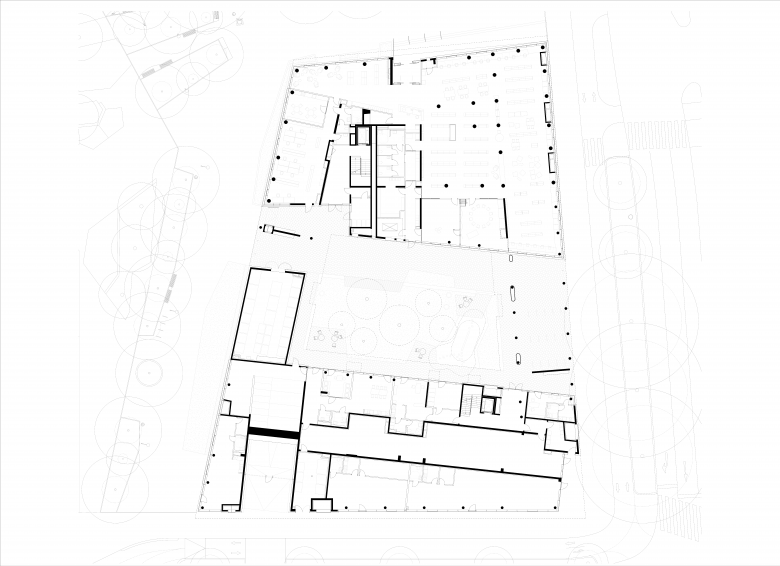
The courtyard as the “green heart” of the housing development responds to the demands that the urban climate makes on open space with densely planted green areas and surfaces that allow water to seep through. The basis for the design concept is a spatial division into calmer areas and those crossed by paths. To the west the courtyard opens to the Neues Landgut site, in an easterly direction there is a way through to Laxenburger Straße, so that the courtyard is also accessible to the public and its permeability is ensured. A raised area that results from a change of level will provide a green retreat for users and residents, a communal place for meetings and exchange.
An opening in the underground garage allows three large trees with different forms of growth to be planted. They will introduce a landscape dimension to the courtyard and will offer all in the district a view of greenery with cool, fresh air and bird song. Vertical planting rooted in the ground and the widespread use of planters on the access decks and balconies ensure a contemporary and adequate adaptation to climate change. Two diverse kinds of light-coloured paving separate the courtyard into areas for movement and areas for rest.
Earth-bound vertical planting and planters ensure that green decks, which they provide an additional apartment-related outdoor space for residents.
Large communal terraces on the roofs provide space for social exchange. The roof terraces augment the offers made to the residents and are devoted to different themes. The roof terraces on the 1st floor offer primarily places to sit and rest. The large roof terrace on the 4th floor is combined with a community room. Seating, areas of planting and a play area for small children make it an agreeable place to spend time. On the small terrace an urban farming area is provided for those interested in gardening. The planted courtyard uses the earth core for planting trees and undergrowth that tolerates shadow and has a natural cooling and climate function. The extensive roof planting uses a variety of plants as well as deadwood structures to create a sheltered area for species of soil animal that are sensitive to frost or drought.
SOCIAL SUSTAINABILITY
Suitability for daily use
Both main entrances to the staircases face onto the planted courtyard. As both are entered from this lively courtyard, the structured perception for the residents is strengthened. The planted, lively courtyard is continued on the upper floors in the form of a classic “Pawlatschenhof”. The important communicative aspect of the Pawlatschenhof structure has a positive impact on sustaining
communication in this large building. Communication between the various parts of the building is strengthened by communal areas that are in visual contact with each other. Bike rooms and pram rooms are distributed on the upper floors. Freedom from barriers in all communal areas is a matter of course. The project offers a high degree of social mix as in all locations and sectors there is a variety of flat types. All apartments are planned for daily life and can be fitted with standard furniture. The storage areas are adapted to user needs and apartment sizes.
Housing for changing needs
The compact floor plans and the ideal positioning of the wet rooms allow the apartments to continue being used even when needs change. Alterations inside the apartment can be made with limited expenditure and offer an opportunity to meet the different housing needs of the residents throughout almost all phases of their lives. The rooms can be used for working, playing, studying, resting, caring, entertaining guests and much more. Elderly people or those in need of care can remain in their familiar environment – perhaps with neighbourhood care from others from the community of people living on the same floor.
Housing in community
The formation of lively neighbourhood communities in the buildings is encouraged by community rooms and areas meant for all. It is intended to offer offices or studios for rent on the 5th, 7th, and 9th floors. They are directly connected to the staircases and can therefore be easily reached.
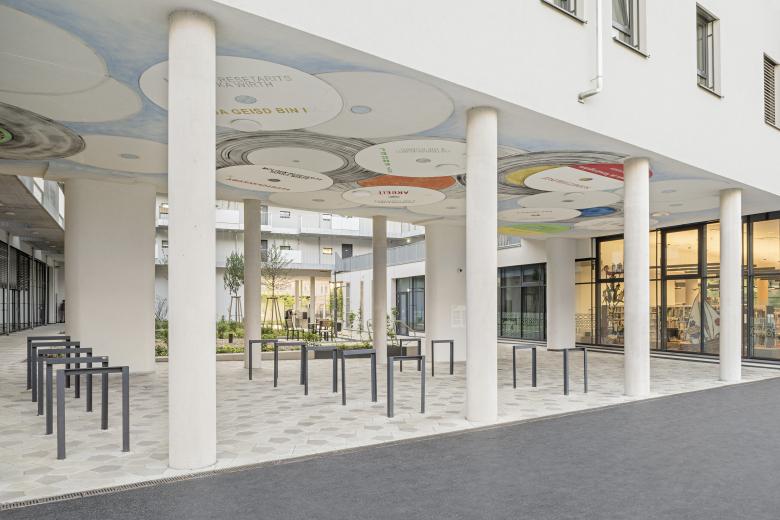
Through the form of the building, which is related to a “Pawlatschenhof”, the communal rooms can be distributed on various levels. The ground floor has a large community room with workshop, laundry, and a playroom for young people. It is located directly in the courtyard, from where it is reached. The courtyard is surrounded by semi-public and private decks and terraces. On the one hand these access decks are the tenants’ main balconies while on the other they also provide access to the flats. Through this mix an interesting mesh of differently used outdoor spaces is woven. On the 1st floor there is a small sun deck that is also open to all residents. The large roof terrace on the 4th floor is bordered directly by the second community room.
ECONOMY
The WIGEBA (Wiener Gemeindewohnungs Baugesellschaft m.b.H.) fulfils the important task of creating affordable living space for the residents of Vienna. For almost one hundred years housing in Vienna has been regarded as an exemplary model in European cities. It is characterised by high quality and innovations and also guarantees the social and economic stability of society. Vienna is growing rapidly, the demand for apartments is high, there is high pressure on the housing market. This makes it even more important to erect affordable apartments and to make these available to residents. These apartments are compact, economical, with no requirement for own funds. What are known as the Gemeindewohnungen NEU (new municipal flats) offer tenants fair conditions and legal certainty.
- Year
- 2024
- Project Status
- Built
- Client
- WIGEBA Wiener Gemeindewohnungs Baugesellschaft m.b.H.
- Team
- Ziviltechnikergesellschaft mbH, Statics, Building physics: Dorr-Schober & Partner, Vienna Building services: Gebäudetechnik Kainer GmbH, Rattersdorf Electrical planning: Elektrotechnik Wunderl ZT GmbH, Rattersdorf Landscape planning: DND Landschaftsplanung, Vienna Art on the building: Johanna Kandl