Education Centre Kössen
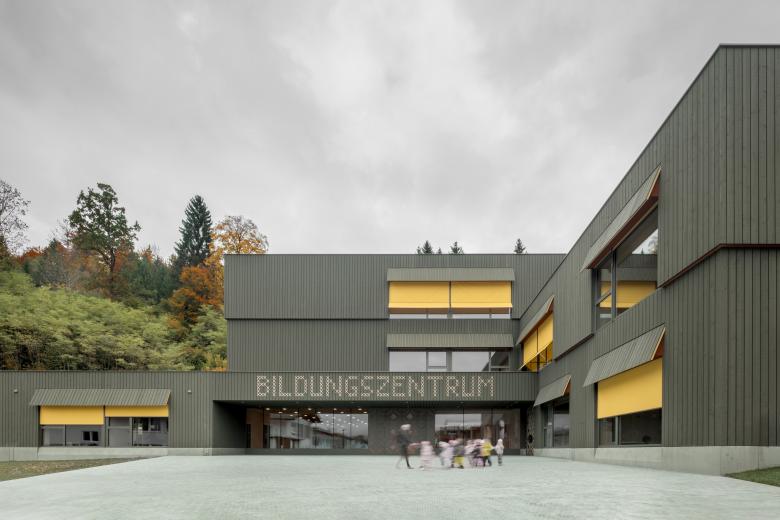
At the northern edge of Kössen’s settlement core, where the road leads toward the triple sports hall and the residential and nursing home for the elderly, everyday village life becomes particularly concentrated. Between the town hall, the church and the local theatre – the familiar center of communal life – a new building is emerging that quietly seeks to connect all these places: the Kössen Education Center.
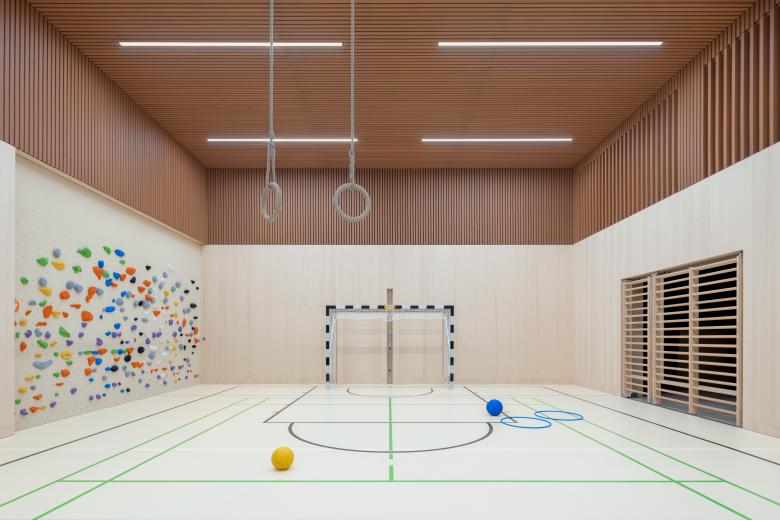
Here, primary school, kindergarten, nursery, after-school care and sports hall are brought together under one roof. What at first glance may appear to be a functional consolidation is in fact a strong statement: a commitment to an educational landscape that connects generations, where learning, playing, working, arriving and lingering naturally interweave.
The education center positions itself as a new focal point at the edge of the village, as a link between the public life of the center and the surrounding residential neighborhoods. It strengthens what already exists while preparing for the future: a building that points spatially and emotionally toward tomorrow for the community of Kössen.
The creation of this building is not a linear process behind closed doors, but a continuous dialogue: between the place, the users and the people who build it. Step by step, a shared vision emerges from conversations, ideas and plans.
Project development is deliberately conceived as a sequence of phases. Initially, user workshops were held to collect needs and everyday scenarios.
These were followed by design and approval planning, discussions with contractors and the development of execution details.
Each phase serves to sharpen the architectural idea and to carry it through to material selection, the joining of building components and future operational scenarios.
Milestones mark moments of collective reflection: the competition decision on 30 August 2022, planning approval on 30 May 2023, the groundbreaking ceremony on 16 October 2023, the topping-out ceremony on 8 August 2024 and, finally, the opening on 26 September 2025. Behind these dates lie countless conversations, decisions and acts of trust, along with the growing awareness that a building is taking shape that will accompany the community for decades to come.
At the beginning stands an attentive look at what already exists: the traditional village and farmhouses of Kössen tell of a robust and calm way of building.
Wide overhanging roofs protect the building volumes, wooden cladding defines the masses, balconies create distinctive horizontal lines, often colorfully finished and richly decorated.
Small, carefully placed openings cut precisely into the façades.
Geometric decorations repeatedly appear: patterns created through the working, coloring and laying of wood. Quiet, yet present.
These images are not simply adopted, but translated into a concept for the education center: robustness and groundedness on the outside, atmosphere and sensory perception on the inside.
Like the large, solid farmhouses, the education center aims to unfold an unpretentious, self-evident presence within the village fabric. At the same time, the interior opens up to spaces that support teaching, play, movement and retreat, with materials “to be touched,” surfaces allowed to age and mature, and spatial sequences that offer calm to children and adults alike.
The education center is conceived as a layered spatial landscape. Different age groups, daily rhythms and needs come together here, while each still finds its own clearly defined areas and legitimacy.
Kindergarten, school and after-school care each have their own entrances, all oriented toward a shared, covered forecourt. This forecourt functions not only as a distributor, but as the common address of the building: here children arrive in the morning, parents say goodbye, teachers and educators meet – sheltered, yet open toward the village and in mutual exchange.
The placement of the building volumes tells this story: the three-story school building extends the existing main axis and marks the edge of the settlement structure. The two-story kindergarten matches the height of the triple sports hall and forms a balanced relationship with it. The single-story after-school care building adopts the scale of the neighboring residential houses and gently mediates toward the housing area.
This graduated development in height simultaneously structures the outdoor spaces, creating plazas, gardens and play areas that can be used in many different ways.
Interior and exterior are not conceived as separate worlds; the spatial configuration becomes an open educational landscape in which paths, visual axes and open spaces naturally interconnect.
Inside as well, the building brings together two apparent opposites: autonomy and community. Each area remains functionally independent, with clearly assigned spaces and processes. At the same time, internal connections, visual relationships and transitional zones repeatedly enable encounters – between classes, between kindergarten and school, and between different age groups.
The building’s color scheme is also closely linked to Kössen. Instead of many tones, a deliberately reduced and clearly legible system is developed: three main colors structure the external appearance and give the building a calm, recognizable identity without slipping into folklore.
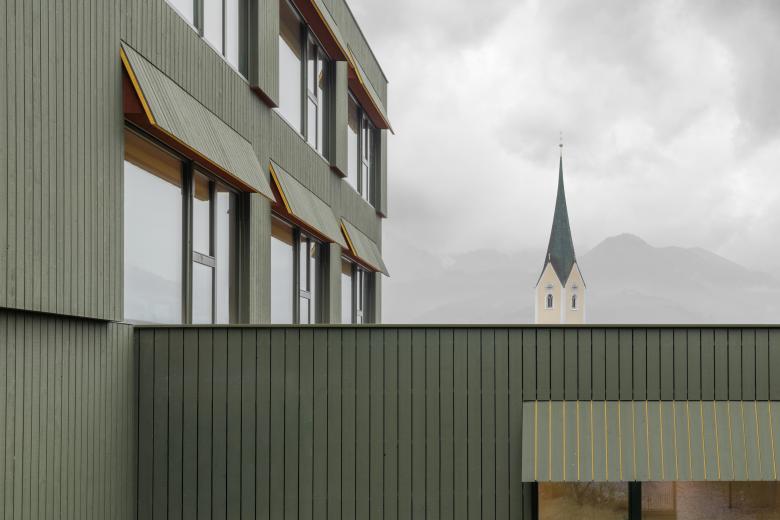
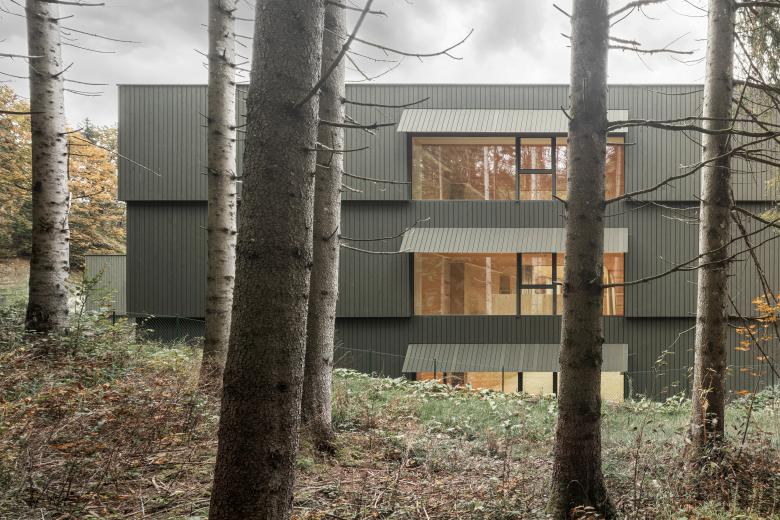
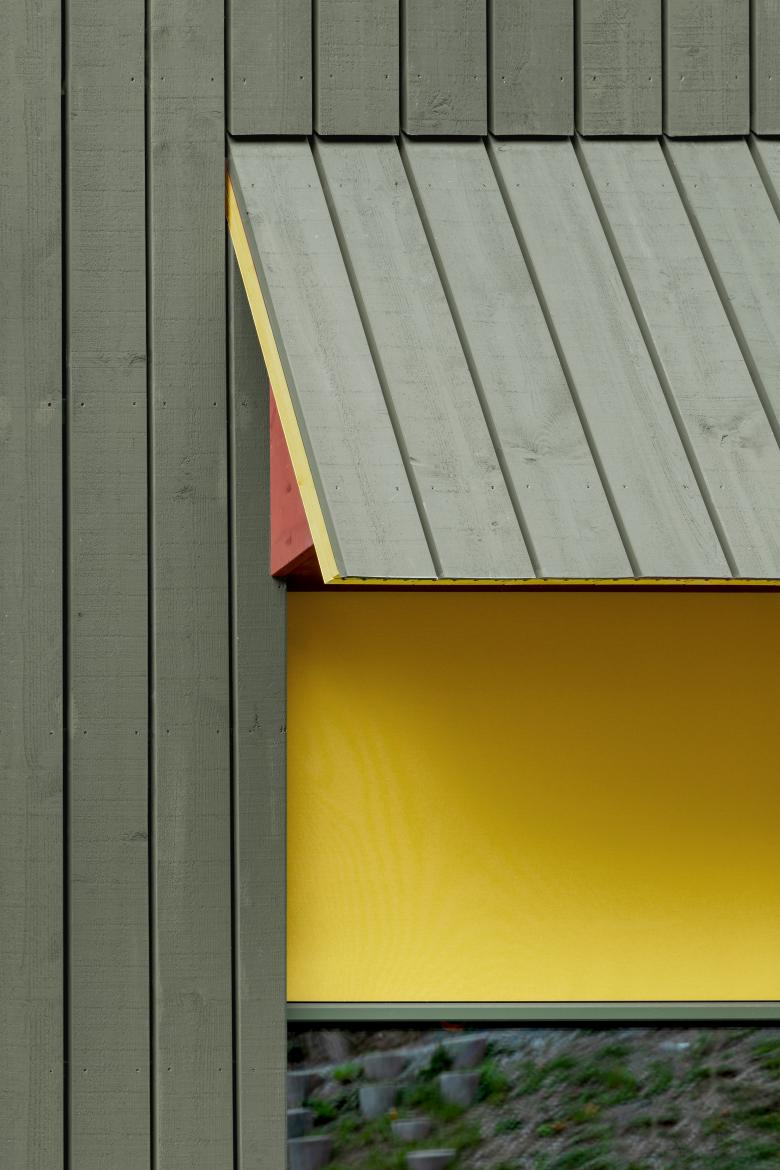
The green-stained wooden façade made of local softwood forms the base – a kind of protective shell with a familiar character. Beneath it are the yellow soffits of the canopies, which, together with the yellow sunshading elements and the red side wings of the canopies, create precisely placed accents.
Color thus becomes a means of order and orientation: façade, canopy and sunshading begin to function like a clear drawing by which children can orient themselves in everyday life.
At the same time, the building envelope is designed as a durable, operationally robust construction. The wooden façade is selected and treated to be UV-resistant, color-stable over time, quick-drying after rain and low-maintenance. The possibility of refreshing the surface at a later date without sanding or priming is part of the strategy, as is preserving the “breathing” properties of the natural material. In this way, the claim of grounded robustness is fulfilled not only in design terms, but over the entire life cycle of the building.
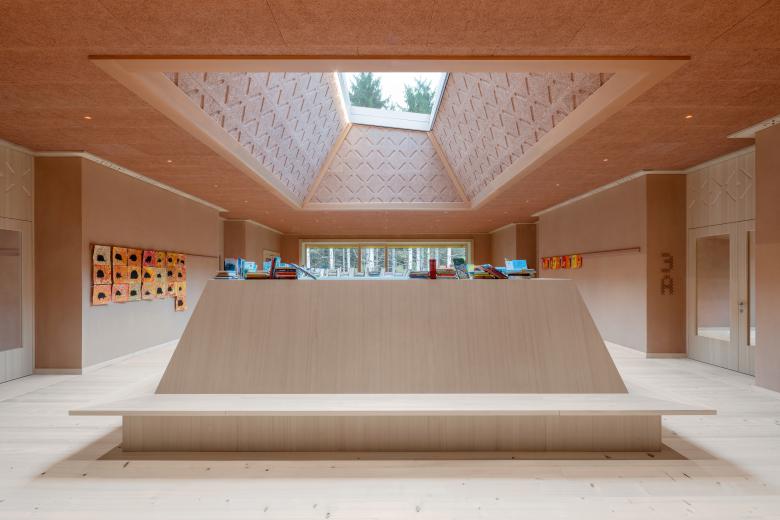
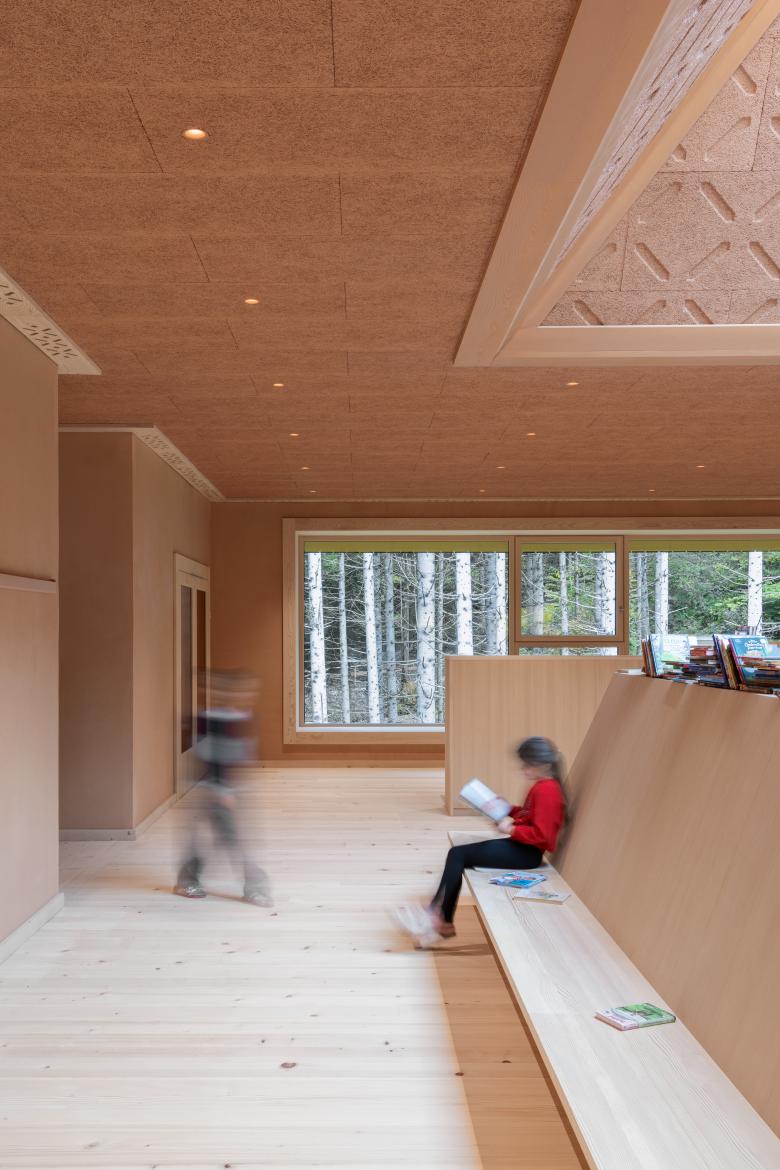
This attitude continues consistently in the interior. Instead of a wide variety of materials, a clear, coherent material palette is applied throughout. Almost all surfaces and built-in elements are made from natural, regional to local materials, used in as raw and authentic a manner as possible.
They are explicitly allowed to age and mature. The building may show traces of use and reflect how it is inhabited. Through touch, smell and color, it will change its appearance over time. In this way, a visible and tangible relationship develops between users and architecture – a story inscribed in the material itself.
Pedevilla Architects describe this basic attitude as “Effect & Intention”: the use of natural, solid, untreated materials; the stimulation of the senses – touching, feeling, smelling, seeing – and a durability that understands aging as a gain in quality.
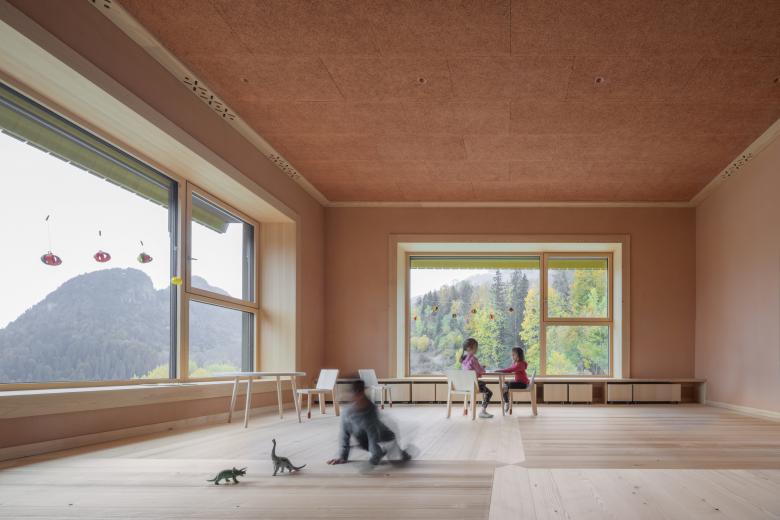
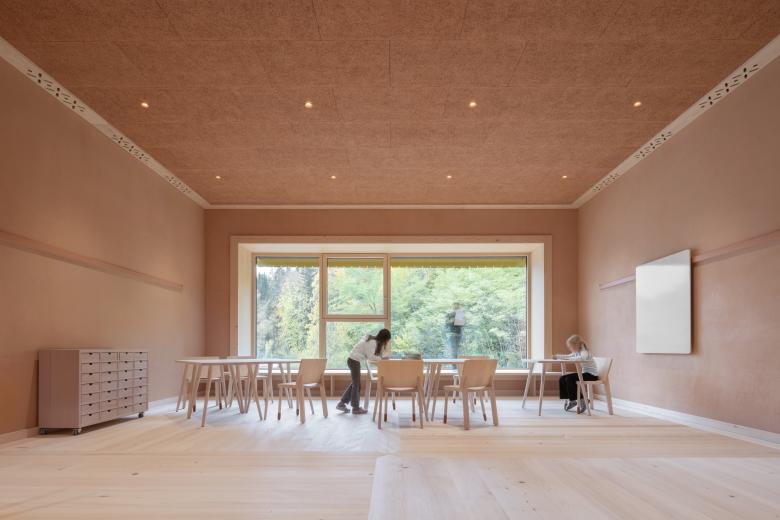
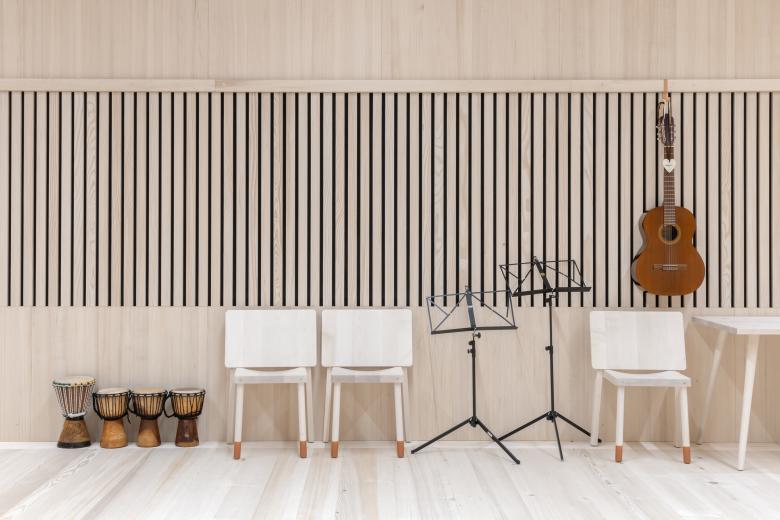
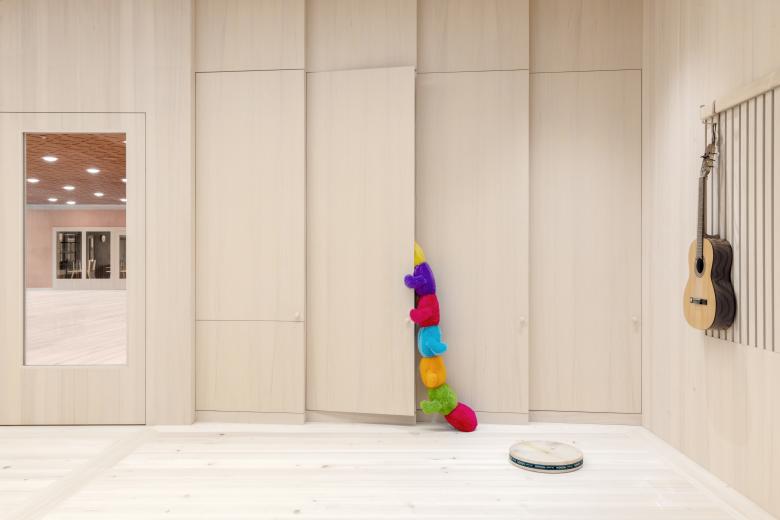
Wood (silver fir), used as solid wood for floors and furniture, forms the tactile foundation in classrooms and group rooms. The warm, light surfaces create a sense of security and are chosen to gain expression with every touch and every use.
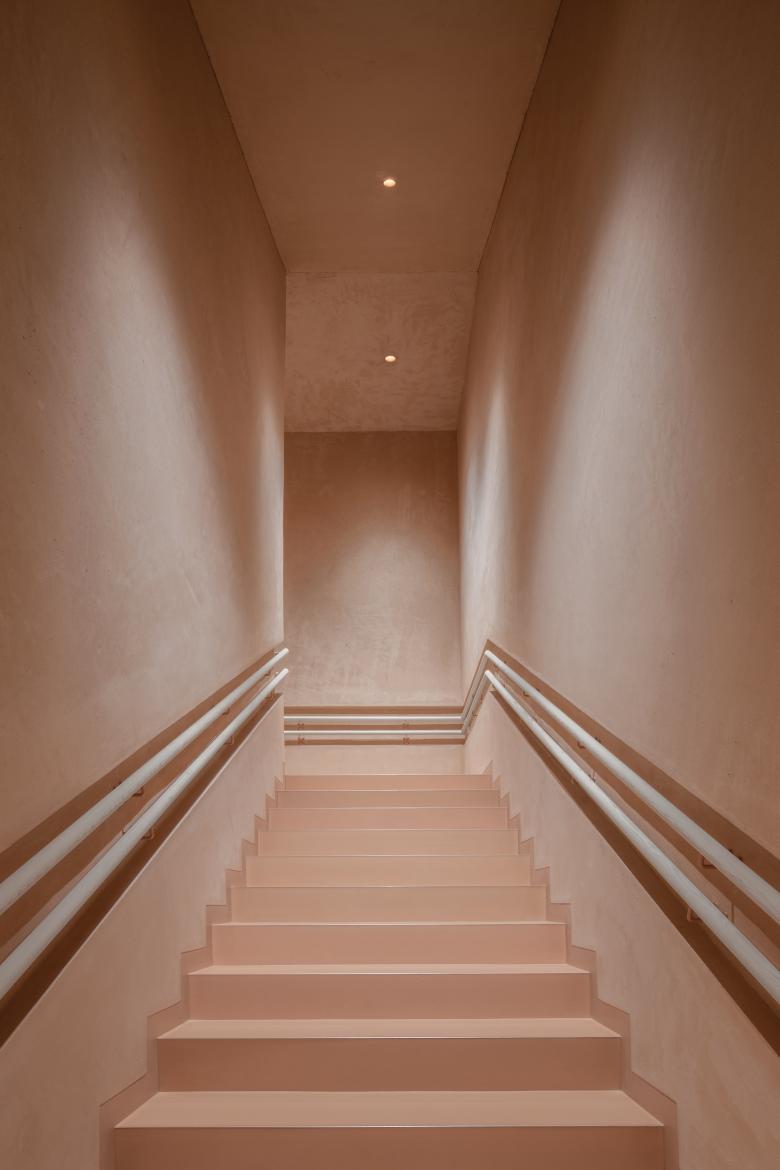
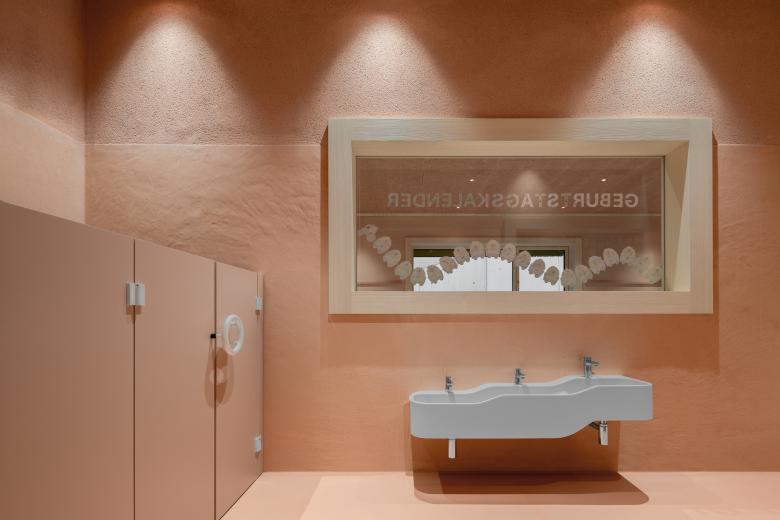
Plaster (lime plaster) is applied as a smooth lime plaster, partly with recycled brick aggregates, on walls and ceilings. The result is surfaces that invite touch, retain smells and leave a lasting impression on children.
Mineral flooring, in the form of a cement-based trowelled finish (Pandomo), is used in heavily frequented circulation areas, translating robustness into everyday suitability, color-coordinated with the plaster.
Acoustically effective ceiling surfaces ensure calm in common and learning spaces.
Textured glass, used in doors to staircases and enclosed rooms, allows just enough light transmission to hint at activity beyond, supporting orientation within the building through coloration coordinated with the plaster.
In their overall interplay, these elements create a calm and durable interior world: outside, a robust and grounded appearance; inside, a warm, tangible materiality – not as a stage, but as a supporting background for education, play and community.
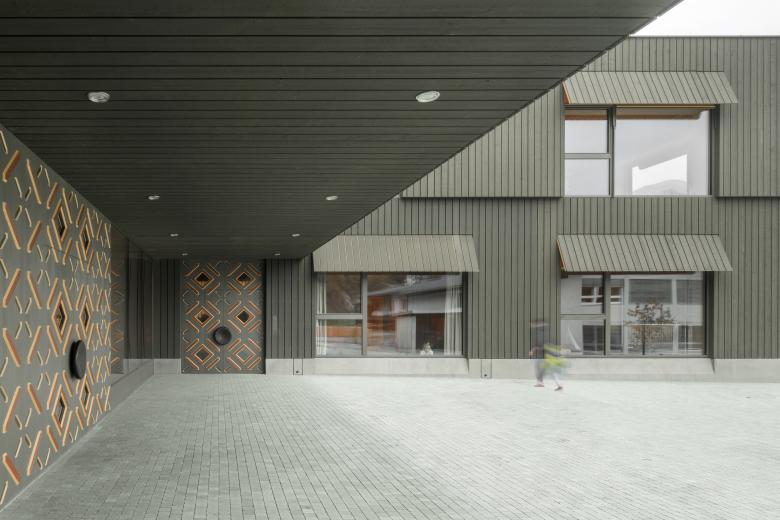
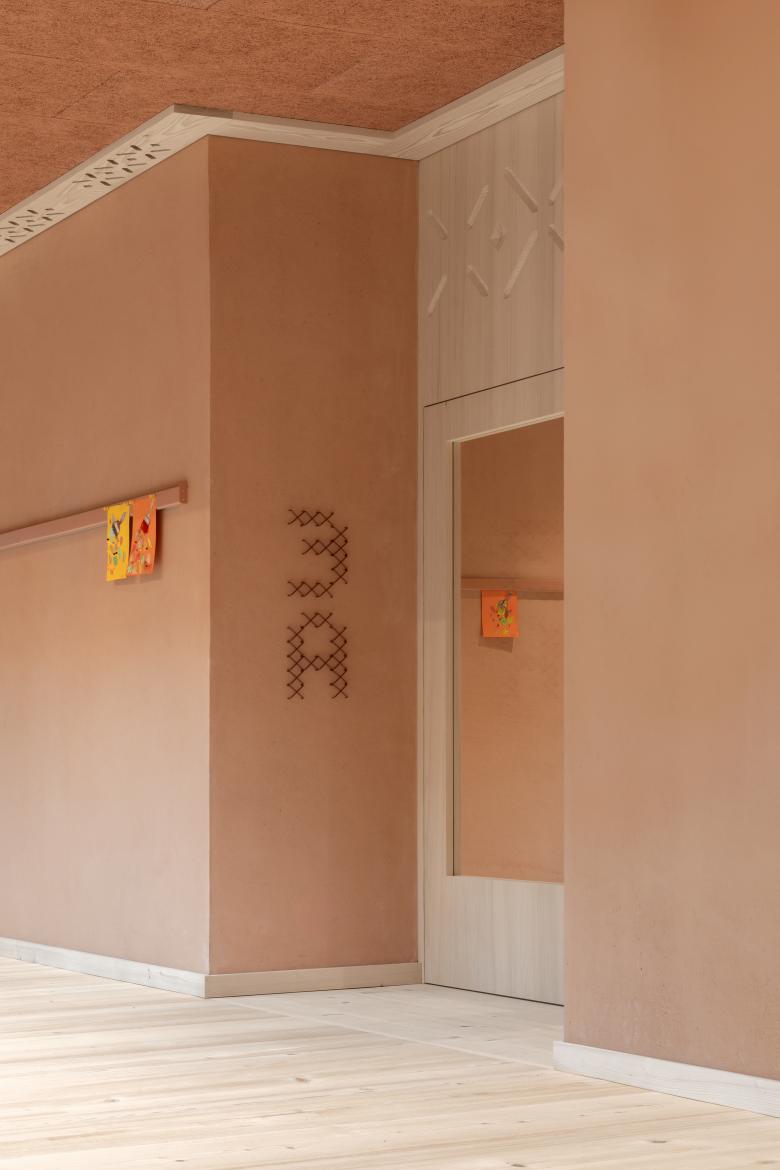
In the details, the reference to place becomes concentrated. A contemporary reinterpretation of the traditional cross-stitch runs through the entire building as a quiet yet consistent thread.
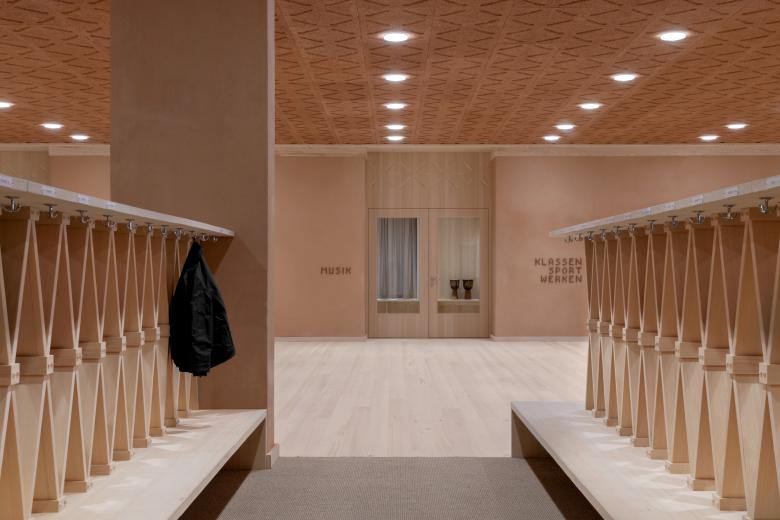
Drawing on the decorative richness of traditional farmhouses, the motif is not cited nostalgically, but developed functionally. It references history by becoming a wayfinding system, a tool for orientation and building organization, while also serving as an element of identification and personalization. It appears as a symbol on cloakroom signs and classroom labels, sets accents, directs attention and fulfills functional tasks such as concealing building services – for example as ventilation outlets within ceiling friezes.
Crucial is its clearly defined and differentiated application: the cross-stitch appears as door decoration for entrance doors and group rooms, as a pattern for ventilation slots, in ceiling designs and skylight domes, along stair railings and in cloakroom signage. Ornament thus transforms from mere decoration into an independent, calm language of value and orientation.
The entrance door plays a special role. As the “face of the building,” it takes up the analogy of historic farmhouse doors and their diamond patterns, translating them into a contemporary form. At this threshold, robustness outward and warmth inward are immediately perceptible – a moment in which the character of the building reveals itself before one even enters.
What begins inside continues outdoors. The exterior spaces are conceived as a nature-oriented learning and movement landscape, tailored to different user groups.
Motor skills equipment, balancing and swinging elements, climbing and hanging structures, sand and water play areas, experiential paths, natural shading and near-natural planting are not distributed randomly. They form a sequence of “places” that interweave movement, quality of stay and contact with nature.
Deliberately considered seasonal images are added: in winter, a slope becomes a sledding run; in summer, a meadow becomes a place to play. In this way, the cycle of the seasons becomes part of the educational narrative, allowing children to experience their outdoor environment in ever-changing states and to learn about nature in transition.
Behind the building stands a multitude of hands and minds. In this project, craftsmanship is not merely the final stage after design, but an integral part of architectural quality from the very beginning.
The consistent material selection – regional to local, raw and durable – and the translation of the ornamental guiding motif into building components and surfaces require close collaboration with regional and local trades. At the same time, trust and careful coordination are needed at the interface with the client, the Municipality of Kössen.
The design process thus becomes a collective effort: user meetings, samples and material presentations, and shared decisions on details ensure that the building remains what it promises to be in the design – durable, suitable for everyday use and deeply rooted in its place.
The Kössen Education Center is far more than a functional infrastructure for teaching and care. It understands itself as an emotional space that accompanies the formative early years of children and their families alike.
Architecture is not conceived as a rigid shell, but as a quiet, reliable companion – a building that conveys security, awakens curiosity and supports children’s development over many years. For Pedevilla Architects, a school is a place where values, community and cultural awareness are formed.
The architecture aims to communicate a sense of protection and stability, free from short-lived trends, shaped by simplicity, warmth and durability. Children growing up in such an environment experience architecture as a cultural quality – something that sustainably influences their perception of learning, coexistence and the world.
The Kössen Education Center thus represents an investment in the future of the community: a building that conveys not only education, but also strengthens emotions, social skills and cultural identities – day after day, year after year.
- Year
- 2025
- Project Status
- Built
- Client
- Gemeinde Kössen
- Working group
- gbd Holding ZT GmbH